When a tree becomes diseased, severely damaged or unsuitable for its surroundings, removing it may be necessary to protect people and property. However, not every tree can be removed in the same way. The most appropriate method depends on the tree’s size, condition, location and the amount of space available around it.
For property owners in Emsworth, Hampshire, understanding the difference between tree felling and sectional dismantling can help clarify what is involved in professional tree removal. Both methods have their place, but choosing the right approach is essential for managing risks and protecting nearby buildings, gardens and other features.
What Is Traditional Tree Felling?
Tree felling involves cutting through the trunk so that the tree falls in a planned direction. This method is generally suitable when there is sufficient clear space for the tree to come down safely without striking buildings, fences, vehicles or other obstacles.
Before felling begins, a professional tree surgeon assesses the tree’s height, natural lean, condition and surrounding environment. The direction of the fall and the available clearance must be considered carefully, as even a healthy tree can behave unpredictably if its structure is compromised.
Where conditions are suitable, traditional felling can be an effective way to remove a tree in a single operation. However, it is not appropriate for every location, particularly where the tree stands close to buildings, boundaries, garden structures or areas that cannot be cleared.
What Is Sectional Dismantling?
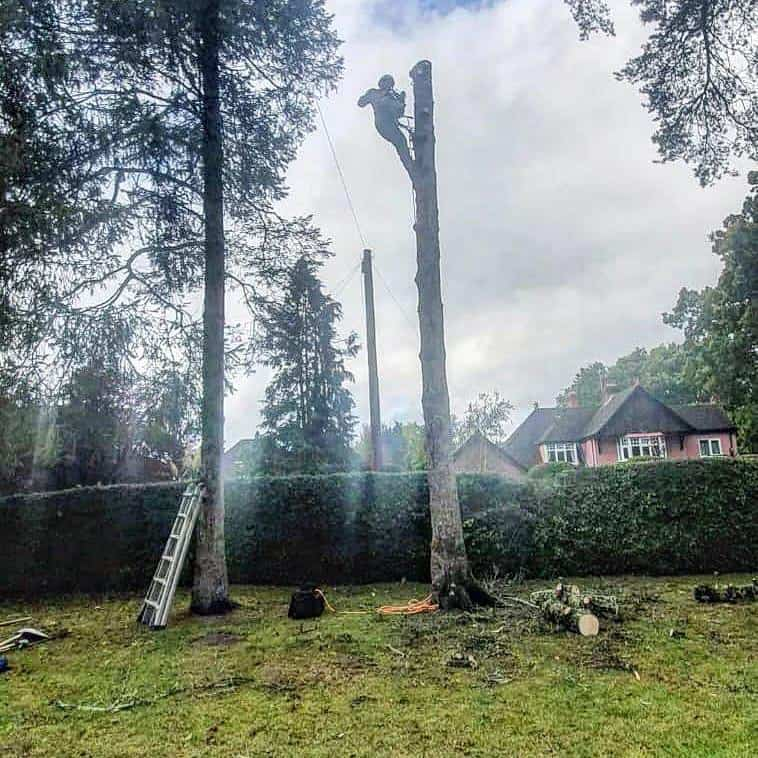
Sectional dismantling involves removing a tree in smaller sections rather than allowing the entire tree to fall at once. A tree surgeon works progressively from the upper crown downwards, removing branches and sections of the trunk in a controlled sequence.
Depending on the site, cut sections may be lowered using suitable rigging equipment to prevent them from falling freely. This approach helps manage the movement of timber where there is limited space or where surrounding features need to be protected.
Sectional dismantling is often suitable for trees in confined gardens, close to buildings or near access routes. It can also be appropriate when a tree is unstable and requires careful removal, although the precise method must be selected following a professional assessment.
The Main Differences Between Tree Felling and Sectional Dismantling
The key difference is how the tree is removed and the space required to carry out the work.
Traditional tree felling requires a suitable area where the tree can be directed to fall. Sectional dismantling allows the tree to be removed piece by piece, giving the tree surgeon greater control over how branches and trunk sections are handled.
The surrounding environment is therefore a major factor. A tree standing in an open area may be suitable for conventional felling, while one positioned beside a house, greenhouse or garden wall may need sectional dismantling.
The tree’s condition also matters. Significant decay, damaged branches or an unstable trunk can affect how safely it can be cut. A professional tree surgeon will consider these factors alongside access, overhead obstructions and the available working area before recommending a method.
When Is Traditional Tree Felling the Better Option?
Traditional felling may be appropriate when the tree has enough unobstructed space around it and can be brought down in a controlled direction.
Examples include trees in open gardens or other areas where there is sufficient clearance from buildings, structures and frequently used spaces. The method may also be considered when a tree needs to be removed completely and site conditions allow the trunk to be felled safely.
However, having an apparently open area does not automatically make felling suitable. The tree’s lean, branch structure, wind conditions and any hidden defects must also be assessed.
Professional planning helps determine whether the tree can be felled safely or whether a more controlled removal method is necessary.
When Is Sectional Dismantling More Suitable?
Sectional dismantling is often the preferred option when a tree cannot be felled safely in one piece. This commonly applies to trees growing close to buildings, sheds, fences, driveways or neighbouring garden features.
It can also be useful where branches extend over areas that need to remain protected during the work. By removing smaller sections progressively, the tree surgeon can manage where the timber goes and reduce the risk of uncontrolled impact.
For properties in Emsworth, Hampshire, where garden layouts and access conditions vary, sectional dismantling can provide a practical solution for removing trees from restricted spaces.
The work requires specialist skills, suitable equipment and careful coordination. It should not be attempted by inexperienced individuals, particularly when large branches or heavy trunk sections are suspended above obstacles.
What Happens to the Tree Stump After Removal?
Removing the tree does not necessarily remove the stump or the remaining root system. Depending on the chosen removal method, the stump may be left in place for later treatment or removed as part of a separate service.
Stump grinding reduces the stump below ground level, making the surface easier to use for lawn maintenance or landscaping. Complete stump removal may be more appropriate where deeper clearance is required, although the amount of excavation depends on the tree and site conditions.
If you intend to replant, install a pathway or redesign the garden, explain your plans before the tree removal begins. This allows the tree surgeon to advise on the most suitable approach for the remaining stump and ground.
Why Professional Assessment Matters
Selecting a removal method involves more than deciding whether a tree can fall in a particular direction. Tree surgeons must consider structural condition, surrounding obstacles, access, the handling of cut timber and the safety of people nearby.
A professional assessment helps identify the safest practical method for the specific site. It also allows the work to be planned around the property, reducing the likelihood of damage to nearby features and helping manage the removal process efficiently.
At LM Tree Surgery Emsworth, we can assess trees that require removal and advise whether traditional felling or sectional dismantling is more appropriate. The recommendation will depend on the tree’s condition, its location and the space available to carry out the work safely.
If you have a tree that needs removing, contact LM Tree Surgery Emsworth to arrange an assessment and discuss the most suitable approach for your property in Emsworth, Hampshire.
Conclusion
Tree felling and sectional dismantling are both established tree removal methods, but they suit different situations. Traditional felling can be appropriate where there is enough clear space, while sectional dismantling offers greater control when a tree stands close to buildings, boundaries or other obstacles.
For property owners in Emsworth, Hampshire, the right choice depends on the tree’s condition and its surroundings. LM Tree Surgery Emsworth can assess your tree and recommend a suitable removal method, helping ensure that the work is planned carefully and your property is considered throughout the process.
Call us on: 01243 979 695
Click here to find out more about LM Tree Surgery Emsworth
Click here to complete our contact form and see how we can help with your tree needs.