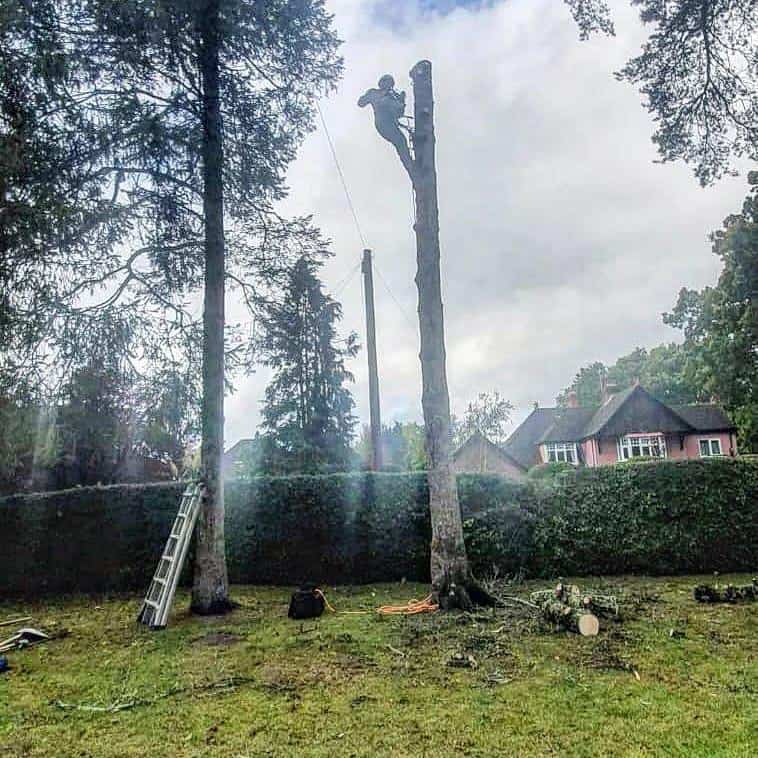
When a tree is removed, it can be tempting to leave the stump behind, particularly if it has been cut close to ground level and does not appear to be causing an immediate problem. Over time, it may simply become part of the garden, surrounded by grass, plants or other landscaping.
However, an old tree stump can remain an inconvenient obstacle many years after the tree itself has disappeared. It can restrict how an area is used, interfere with garden maintenance and make future landscaping unnecessarily difficult. Depending on the tree species and condition of the stump, it may also produce unwanted regrowth or gradually decay.
For homeowners in Emsworth, Hampshire, professional stump grinding can provide an effective way to finally deal with an old stump and reclaim the space it occupies.
Why Can Tree Stumps Remain for So Long?
Tree stumps consist of dense woody material connected to an established root system beneath the ground.
Although the stump will gradually decay naturally, this can be a very slow process. Larger stumps in particular may remain noticeable for many years.
The fact that a stump has been present for a long time does not necessarily mean it will disappear conveniently in the near future.
If it is already interfering with how you want to use the garden, waiting for natural decomposition may simply prolong the inconvenience.
An Old Stump Can Waste Useful Garden Space
The amount of space occupied by one stump may initially appear insignificant.
However, its position can make a substantial difference.
A stump in the middle of a lawn, beside a path or within an area you would like to redesign can dictate how the surrounding garden is arranged.
Removing it can provide greater flexibility for:
- Extending lawn areas
- Creating new planting beds
- Improving garden paths
- Reorganising seating areas
- General landscaping
- Making better use of awkward corners
- Creating a more open garden layout
If your plans repeatedly have to accommodate the stump, dealing with it can be worthwhile.
Stumps Can Make Lawn Maintenance More Awkward
Old stumps are particularly inconvenient when they remain within lawns.
Even if the stump has been cut relatively low, you may need to mow around it every time the grass is cut. Grass and weeds can also grow closely around the remaining wood, creating an awkward area that is difficult to keep tidy.
Exposed roots can add to the problem.
Professional stump grinding removes the main woody obstruction below the surrounding surface, allowing the area to be prepared for whatever use is intended next.
What Is Stump Grinding?
Stump grinding is a specialist tree surgery service used to mechanically reduce the remaining tree stump.
A stump grinder uses a powerful cutting wheel to progressively grind away the timber. Rather than attempting to excavate the entire stump and root system in one piece, the machine deals directly with the unwanted woody material.
The stump can be reduced below ground level, removing the prominent obstruction and making the area considerably easier to incorporate into the surrounding garden.
Stump Grinding Is Different From Complete Root Removal
It is useful to understand what stump grinding is intended to achieve.
Trees can have root systems extending considerable distances through the surrounding ground. Stump grinding does not normally involve excavating every remaining root.
Instead, the process concentrates on the stump itself and relevant accessible root material around it.
The remaining underground roots can then gradually break down naturally.
For many garden situations, removing the main stump obstruction is what makes the biggest practical difference.
Old Stumps Can Become Trip Hazards
A low stump can sometimes be harder to notice than a tall one.
As grass, weeds and surrounding plants grow around it, the stump can blend into the garden while remaining a solid obstruction.
This can be particularly inconvenient where it is located close to:
- Garden paths
- Lawn areas
- Frequently used access routes
- Seating areas
- Garden entrances
Grinding the stump can help create a clearer, more usable surface and remove an obstacle that people have spent years walking around.
Decaying Timber Changes Over Time
Once the main tree has been removed, the remaining stump is no longer maintained in the same way as a living tree.
The timber gradually begins decomposing.
As this happens, the stump can become softer, irregular and increasingly weathered. Fungi and organisms associated with decomposing timber may also become established as part of the natural decay process.
Some homeowners are perfectly comfortable leaving deadwood within particular garden environments. However, where the objective is a tidy, usable landscaped space, an old decomposing stump may not fit with those plans.
Can an Old Stump Produce New Growth?
Some tree species are capable of producing new shoots after the main tree has been removed.
These may emerge directly from the stump or from parts of the remaining root system.
If the tree was removed specifically because it was no longer wanted in that position, repeated new shoots can become frustrating.
Simply cutting the new growth back whenever it appears may provide only temporary control.
Professional stump grinding removes the main stump structure and can form part of dealing with unwanted regrowth around the former tree position.
Why Not Simply Dig the Stump Out?
Small stumps can sometimes look as though they should be straightforward to excavate.
The difficulty is what lies beneath the surface.
The stump may be connected to substantial structural roots extending firmly into the surrounding ground. Attempting to dig everything out manually can require considerable excavation and cause unnecessary disturbance to the garden.
Stump grinding provides a more targeted approach.
Instead of trying to pull the complete stump and root system from the soil, specialist machinery progressively reduces the unwanted stump in its existing position.
An Old Stump Can Restrict Future Landscaping
Perhaps the stump has not bothered you for years because you have had no reason to use that particular section of the garden.
That can change quickly when new landscaping is planned.
A stump may become an obstacle if you want to:
Create a new lawn
The remaining timber prevents the area from becoming part of a continuous usable surface.
Reorganise planting
The stump and substantial roots around it can restrict how the immediate area is approached.
Improve a garden path
A path may need to be diverted simply because the stump occupies the preferred route.
Redesign the garden
An old stump can unnecessarily influence a layout that would otherwise work better without it.
Addressing the stump before beginning wider landscaping can provide a much cleaner starting point.
Do Not Design the Garden Around an Unwanted Stump
When a stump has existed for many years, homeowners can become accustomed to working around it.
The lawn curves around it. Plants are positioned to disguise it. Paths avoid it.
If you genuinely like the stump as a garden feature, this may be intentional. If not, there is little reason for it to continue determining how the surrounding space is used.
Removing the obstruction allows the garden layout to be based on what works best for the property rather than where an old tree happened to grow.
Does the Age of the Stump Affect Grinding?
Older stumps may have begun decomposing, but that does not necessarily mean they can simply be ignored or removed without suitable equipment.
Every stump is different.
Its size, species, position, degree of decay and surrounding conditions can all influence how the work should be approached.
Professional assessment is useful for determining suitable access for the stump grinder and identifying nearby garden features that need to be considered during the work.
Access Is an Important Consideration
Stump grinding requires specialist machinery to reach the working area.
Before carrying out the work, access through the property and around the stump needs to be considered.
A stump situated within an open garden presents different working conditions from one positioned close to fencing, planting, paths or other established features.
Professional planning allows the work to be approached according to the actual site rather than treating every stump in the same way.
Several Old Stumps Can Be Dealt With Together
Some gardens contain more than one stump from trees or larger shrubs removed at different times.
Individually, each one may appear relatively insignificant. Together, they can make lawn maintenance and future landscaping considerably more awkward.
Where access and site conditions allow, several unwanted stumps can be assessed as part of the same stump grinding project.
This can be particularly useful before a wider garden redesign.
Think About What You Want to Do With the Area Afterwards
Before arranging stump grinding, it is useful to decide how you would ideally like to use the space.
The answer might be lawn, planting or simply a clearer section of garden.
Knowing the intended outcome helps provide context for the work.
The objective is not merely to grind away visible timber. It is to remove an obstruction so the garden can be used more effectively afterwards.
Why Professional Stump Grinding Is Worth Considering
Stump grinding involves powerful specialist equipment operating around dense timber, soil and potentially nearby garden features.
Professional tree surgeons can assess the stump and surrounding area before beginning work, considering its dimensions, access requirements and location.
This provides a controlled approach to removing the main obstruction without the extensive excavation associated with attempting to remove the entire root system manually.
Even if the tree disappeared many years ago, there is no reason the stump has to remain indefinitely simply because it has always been there.
Professional Stump Grinding in Emsworth
At LM Tree Surgery Emsworth, we provide professional tree surgery and stump grinding services throughout Emsworth, Hampshire.
Whether a tree has only recently been removed or the stump has occupied your garden for many years, we can assess its size, position and surrounding conditions before determining an appropriate approach.
Removing an unwanted stump can help create a cleaner, more practical garden and provide greater freedom for future landscaping without having to continually design around the remains of an old tree.
Conclusion
A tree stump can remain in a garden long after the tree itself has become a distant memory. Although leaving it may initially seem harmless, an old stump can restrict landscaping, complicate lawn maintenance, create an awkward obstruction and occupy space that could be used much more effectively.
Professional stump grinding provides a practical way to remove the main woody obstruction without excavating the complete root system. It can be particularly worthwhile when you are planning improvements or have simply decided that an old stump no longer has a useful place in the garden.
For homeowners in Emsworth, Hampshire, LM Tree Surgery Emsworth provides professional stump grinding tailored to the individual site. If an old tree stump is still taking up valuable garden space years after the tree was removed, contact our team to arrange an assessment and discuss the most appropriate way to deal with it.
Call us on: 01243 979 695
Click here to find out more about LM Tree Surgery Emsworth
Click here to complete our contact form and see how we can help with your tree needs.